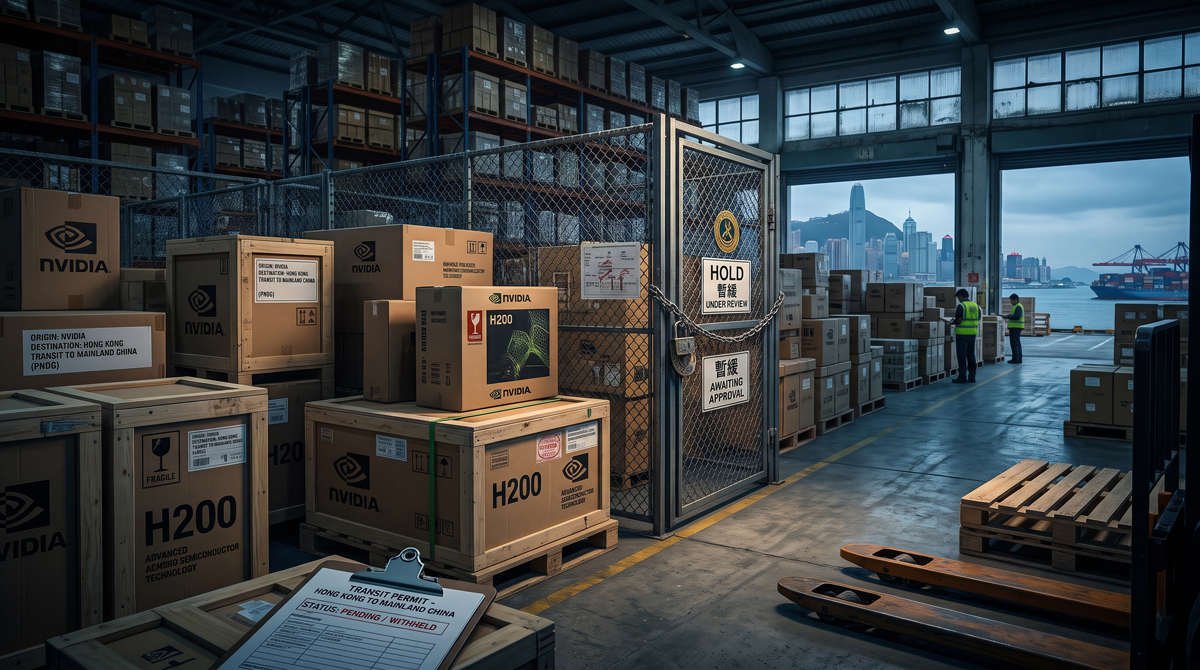
About 600,000 of Nvidia’s advanced AI chips are stored in Hong Kong awaiting shipment to mainland China, as Beijing withholds approval for large-scale imports despite demand from technology firms.
The stockpile of H200 chips, which has not previously been reported, reflects Beijing’s reluctance to increase reliance on US technology, Reuters reported on November 5. Several major Chinese internet companies have each obtained about 10,000 H200 chips in recent months, one person said, but Beijing has yet to approve large-volume imports. China’s industry and planning ministries did not respond to requests for comment, Reuters reported, and neither did Nvidia or Alibaba, ByteDance, DeepSeek and Tencent.
Washington opened the door. Beijing hasn’t walked through.
Hundreds of thousands of H200 chips were approved on paper. Roughly 600,000 now sit in Hong Kong while Beijing holds back large-scale imports.
Approved but not delivered
Reported approvals, estimates and deliveries of Nvidia H200 chips for China, by source and date.
Figures come from separate reports published at different times and are not a single dataset. Delivery figures are for each company’s reported shipment to date.
From approval to stockpile
Nvidia licences: Nvidia 10-Q, quarter ended July 26, 2026, via Progressive Robot
Huawei Ascend 960DT: Huawei Connect 2026, via AI News Daily
What is stuck in Hong Kong
The H200 is Nvidia’s Hopper-architecture AI accelerator, the chip Chinese AI labs want for training large models, and the one US export controls have kept out of China since 2022.
What has crossed the border so far is a trickle. The Financial Times reported in August that ByteDance and Tencent had each taken delivery of roughly 10,000 H200 accelerators, the first meaningful movement since the December 2025 approval, and that Beijing wanted most of each company’s licensed allowance kept off the mainland. Nvidia said the same in its own filing: in its 10-Q for the quarter ended July 26, 2026, it said the US government had granted licenses for small amounts of H200 products, “but such sales were restricted by the PRC government, and we have been unable to sell all the products for which we have licenses.”
…such sales were restricted by the PRC government, and we have been unable to sell all the products for which we have licenses.
Nvidia 10-Q, quarter ended July 26, 2026
The reversal
The United States barred exports of the H200 to China before President Donald Trump’s administration gave Nvidia permission last year to sell the chips to approved Chinese customers, Reuters reported. On December 8, 2025, Trump announced that the United States would allow Nvidia to sell H200 chips to approved customers in China, with the US government taking a 25 percent cut from each sale. The Commerce Department followed on January 13, 2026, with a rule moving licence reviews to case-by-case review.
Beijing’s answer, in January, was approval with conditions, then hesitation. On January 28, Reuters reported that ByteDance, Alibaba and Tencent had been approved to buy more than 400,000 H200 chips in total, and that the Chinese government was only granting approvals with conditions, which were still being decided. The Information reported in July that total approvals could amount to fewer than 200,000 chips and that Beijing wanted firms to prioritise Chinese processors for inference, Reuters reported. That July figure is less than a third of the 600,000 chips now reported to be sitting in Hong Kong.
The price signal
When a legal channel is narrow, a grey market sets the price. An eight-card H200 server was offered for more than 6 million yuan ($900,000) in mainland China by the end of October, about three times its price a year earlier, one person familiar with the matter said. The Seoul Economic Daily reported on November 2 that high-bandwidth memory for Huawei was being packaged with low-end server processors, shipped via Hong Kong, and stripped in China by melting the solder, with the memory intended mainly for Huawei’s Ascend 960DT, due in the first quarter of 2027.
The domestic alternative
Beijing’s reluctance is also industrial policy. Huawei’s Ascend 960DT will be ready in the first quarter of 2027, three quarters early, with 2 petaFLOPS of FP8 compute, up to 288GB of on-chip HBM and 9.6TB/s of memory bandwidth, according to a report on Huawei Connect 2026. Analysts place its performance between Nvidia’s H200 and B300, the same report said. Alibaba’s T-Head unit unveiled the Zhenwu V900 in September, with 216GB of memory and a claimed threefold performance gain over its predecessor, according to a report on the launch. STAR Market Daily reported on November 3, via TechNode, that DeepSeek reportedly plans to train its V5 model on Huawei Ascend chips, a report unconfirmed by both companies.
The offshore workaround
When the chips cannot go to China, the compute can come to the Chinese firms, at least for now. Moonshot AI, the Beijing lab behind the Kimi models, has discussed renting Nvidia Blackwell computing capacity from neocloud operators in Europe, CNBC reported on November 5, citing four people familiar with the private talks. Talks included clusters of 8,000 or more GPUs, CNBC reported, and one source said a proposal called for Moonshot to pay 30 percent to 50 percent more upfront than a non-Chinese customer. Moonshot did not respond to CNBC’s requests for comment, and no deal was reported as signed. US export controls effectively prohibit Blackwell imports into China, but current law does not give regulators broad authority over access to controlled chips through cloud services hosted overseas, CNBC reported.
The Oracle case shows the same workaround closing from the other side. Oracle has reportedly cancelled a five-year AI chip leasing agreement with Tencent worth an estimated $7 billion, the Financial Times reported on November 4, citing people familiar with the matter. The deal would have given Tencent access to as many as 100,000 advanced AI processors housed across Oracle data centers in Southeast Asia, after US officials approached Oracle with concerns over the contract.
What is not proven
The 600,000 figure is the story’s centre, and it is also its weakest point. It comes from two unnamed people, and no official has confirmed the number on the record. The price figure is a reported offer, not a transaction, and the HBM smuggling route is a single report that has not been independently confirmed. The DeepSeek V5 on Ascend plan is explicitly unconfirmed. The Moonshot European talks are discussions, not a signed deal.
What is established, on the record, is the policy shape: Washington moved from a ban to case-by-case licensing with a 25 percent revenue share, Nvidia said in its own filing that its licensed sales were restricted by the Chinese government, and Beijing has granted permission only with conditions that were still being decided.
What to watch next
Nvidia reports fiscal third-quarter 2027 results on Tuesday, November 17, with a conference call at 5 p.m. ET, according to the company’s announcement, and it has guided to about $108 billion in revenue for the quarter. What it says about China, and about H200 inventory, will be the first hard data point since the Reuters report. The next clues are whether Beijing approves any large-volume import, whether Huawei’s Ascend 960DT arrives in the first quarter of 2027 on schedule, and whether the Oracle cancellation, if confirmed, is followed by a formal rule on offshore compute access. The chips are not moving. The question is which side moves first.
Source: Reuters, via WNFL Sports; The Information, via Reuters; Financial Times, via Reuters; CNBC, via Unite.AI and Oossa; Huawei Connect 2026, via AI News Daily; Alibaba Apsara Conference, via Wilson’s Media; STAR Market Daily, via TechNode; Nvidia 10-Q, via Progressive Robot