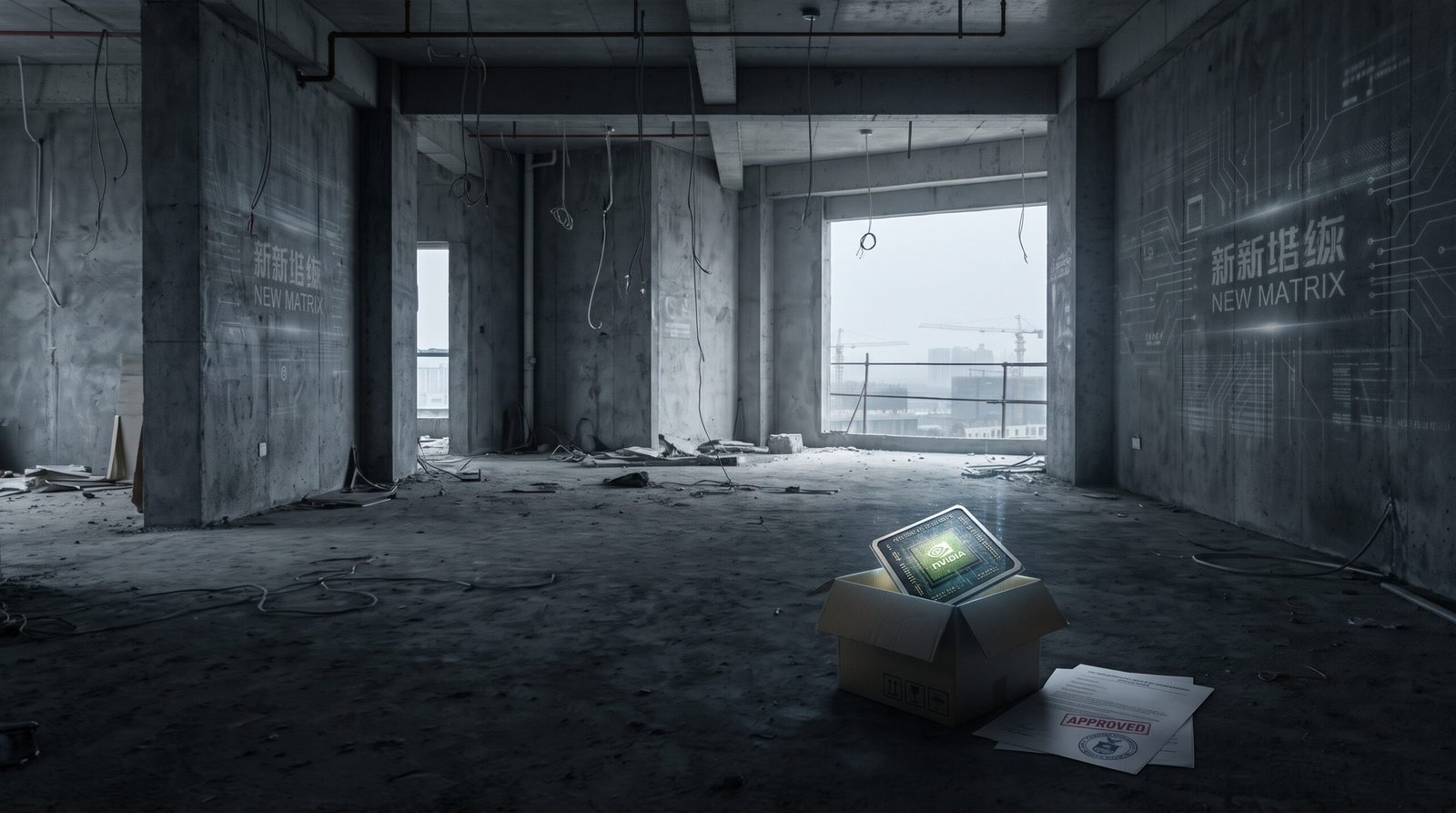
The U.S. Department of Commerce approved a Chinese company whose listed Beijing office is an unfinished concrete shell to assemble Nvidia’s H200 artificial intelligence chips into servers, the New York Times reported Nov. 7, raising questions about how closely Washington vets the buyers of processors it agreed to let into China last year.
The company, New Matrix, was created about 17 months ago and was approved earlier this year, according to the Times report. A Times reporter who visited the listed address, in an industrial park on the northwest edge of the city, found a gray shell with wires dangling where lights should be, and property managers said they had no record of the company. Corporate records cited by the newspaper link New Matrix’s owners to Wise Road, a Chinese private equity fund the U.S. added to its Entity List, the trade blacklist that restricts exports to named foreign parties, in 2024. Two analysts told the Times that New Matrix may be a front for companies tied to that fund. That is their assessment, not a government finding, and no charges have been reported.
A spokesman for the Bureau of Industry and Security, the Commerce Department agency that administers export controls, said the bureau reviews every application for national security risk. He cited US$324 million in export-violation penalties in 2025 and more than 90 enforcement officers hired this year. Nvidia spokesman John Rizzo said it makes no sense for the Chinese military to depend on American technology.
A second licensee
The Times reported in September that the listed office of another licensee, Maginfra, also appeared deserted. Analysts told the newspaper it shares staff and patents with Inspur, a Chinese server maker on the Entity List for its work with the Chinese military, and may be an offshoot. Two more licensees, Zhejiang Yindun Cloud Technology and Shanghai Jiatang, are tied through their owners to companies that serve the Chinese military, though no transfer of chips has been alleged for either.
The Commerce Department has approved roughly two dozen Chinese firms to buy or handle H200s, according to people familiar with the approvals cited in the Times report. The full list is not public. The reporting does not accuse Nvidia of breaking any rule, and the ownership and staffing links it describes are not proof that any chip was diverted.
Chips waiting offshore
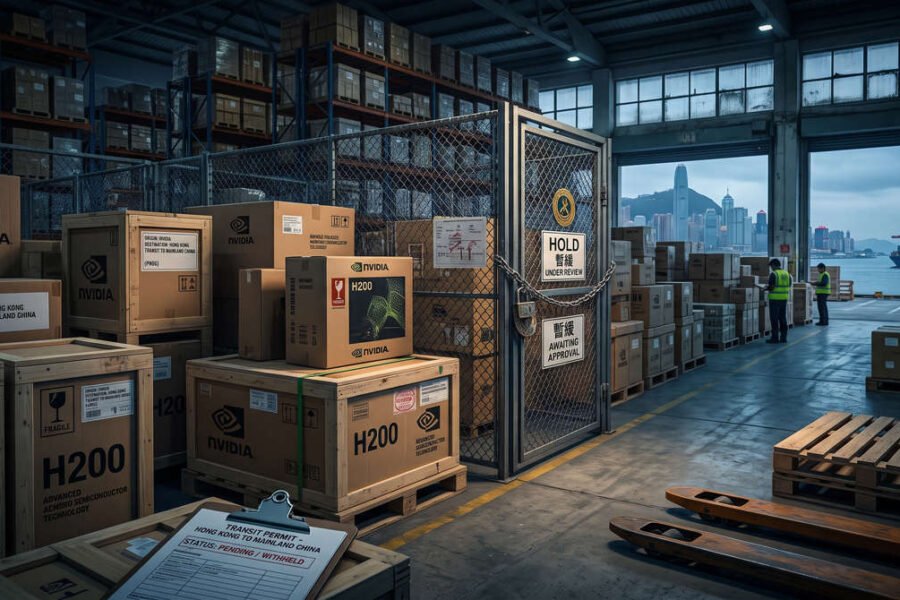
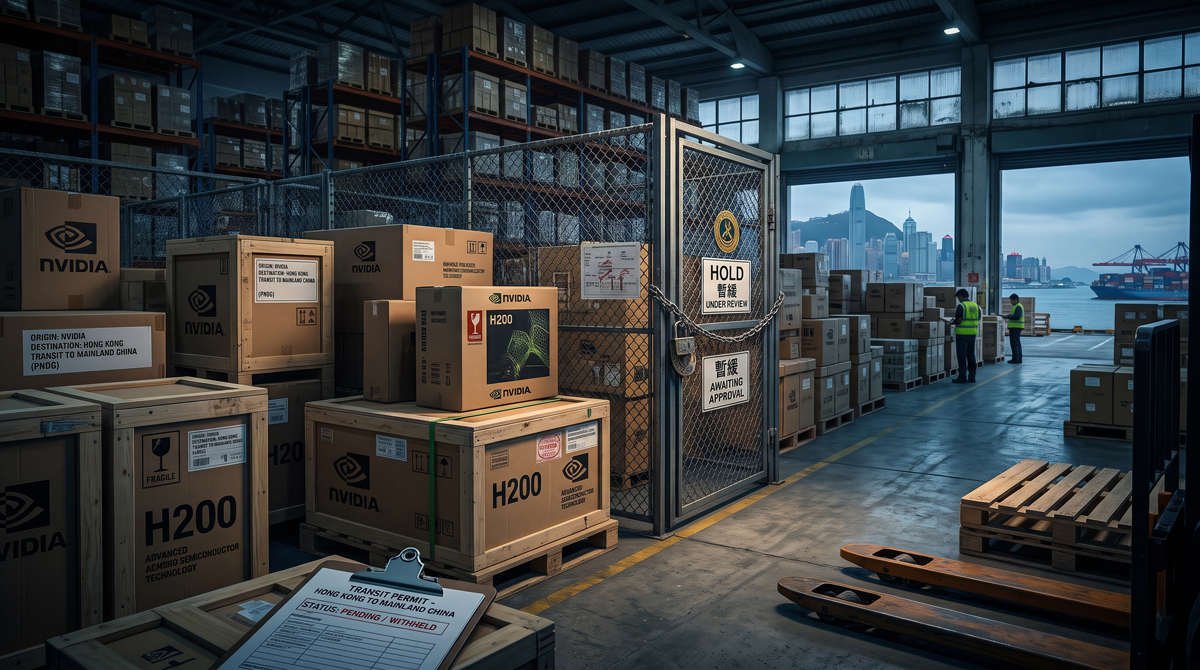
The Trump administration allowed H200 sales to approved Chinese customers in December 2025, and a formal licensing framework followed in January. Chinese authorities, however, decide whether the chips can enter the country. About 600,000 H200s are stored in Hong Kong awaiting shipment to mainland China, two people familiar with the matter told Reuters on Nov. 5, because the government in Beijing has not approved large-volume imports. One source said several major Chinese internet companies have each obtained about 10,000 of the chips in recent months. Reuters said Alibaba, ByteDance, DeepSeek and Tencent did not respond to requests for comment.
Reuters reported Jan. 28 that Chinese authorities had approved purchases by ByteDance, Alibaba and Tencent totalling more than 400,000 H200s, subject to conditions. Reuters also cited a July report by The Information that Beijing’s total approvals could stay under 200,000. In its quarterly filing for the period ended July 26, Nvidia said U.S. licences covered only small amounts and that Chinese government restrictions had kept it from selling all of them. H200 sales to China were under one per cent of its data centre revenue, and it took a US$400 million charge on unsold H200 inventory.
Congress asks questions
Three Republican House chairs, Brian Mast of Foreign Affairs, John Moolenaar of the Select Committee on the Chinese Communist Party and Rick Crawford of Intelligence, have asked Nvidia chief executive Jensen Huang for a closed-door briefing on Nov. 18. They want to discuss his dealings with Alice Huang, a former managing director of Megaspeed, and Nvidia’s safeguards against foreign espionage. Megaspeed has faced allegations, which Nvidia says were investigated and debunked last year, that Nvidia chips were diverted to China. The letter is dated Nov. 4 and was made public the next day. Attendance is voluntary, and Nvidia declined to say whether Jensen Huang will appear.
The Times reported Oct. 29 that U.S. intelligence officials concluded Alice Huang was a Chinese intelligence asset passing commercial information to Beijing, and that officials do not believe Jensen Huang knows of her activities. Nvidia has said his interactions with her were “not unusual or unexpected.” The Chinese embassy called the allegations “groundless smears and slanders.” The claims rest on unnamed sources, and no charges have been reported.
Nvidia reports fiscal third-quarter results Nov. 17 after markets close, with a call at 2 p.m. PT, a day before the requested briefing. The Bureau of Industry and Security also filed a rule on Nov. 5 extending to Jan. 10, 2027 the suspension of its “affiliates rule”, which would require licences for subsidiaries 50 per cent or more owned by blacklisted parties. The Times’s account ties New Matrix and Maginfra to listed entities through ownership and staffing, the kind of connection that rule addresses, though neither the Times nor the filing says it would apply to either company.