Editor’s note: This story was first published March 26, 2026. It was updated Nov. 2, 2026, with the latest on quota use, deliveries and automaker timelines.
More than nine months after Ottawa slashed tariffs on Chinese-made electric vehicles from 100% to 6.1%, the rush to claim the Canadian market has proved slower than advertised.
The first import window closed in August with more than a third of its 24,500 slots unused. Most of the Chinese automakers that announced plans this spring to hire staff, file trademarks and scout dealerships have yet to start selling to Canadian consumers. Lotus is the exception.
In March, at least three of China’s largest automakers were hiring staff, filing trademarks, scouting retail locations, and pushing vehicles through Transport Canada’s certification process — at a pace that caught parts of the domestic auto industry off guard. Since then, timelines have slipped.
The starting gun was the January 16 trade agreement between Prime Minister Mark Carney and President Xi Jinping, which created a quota allowing 49,000 Chinese-built EVs into Canada each year at the reduced rate.
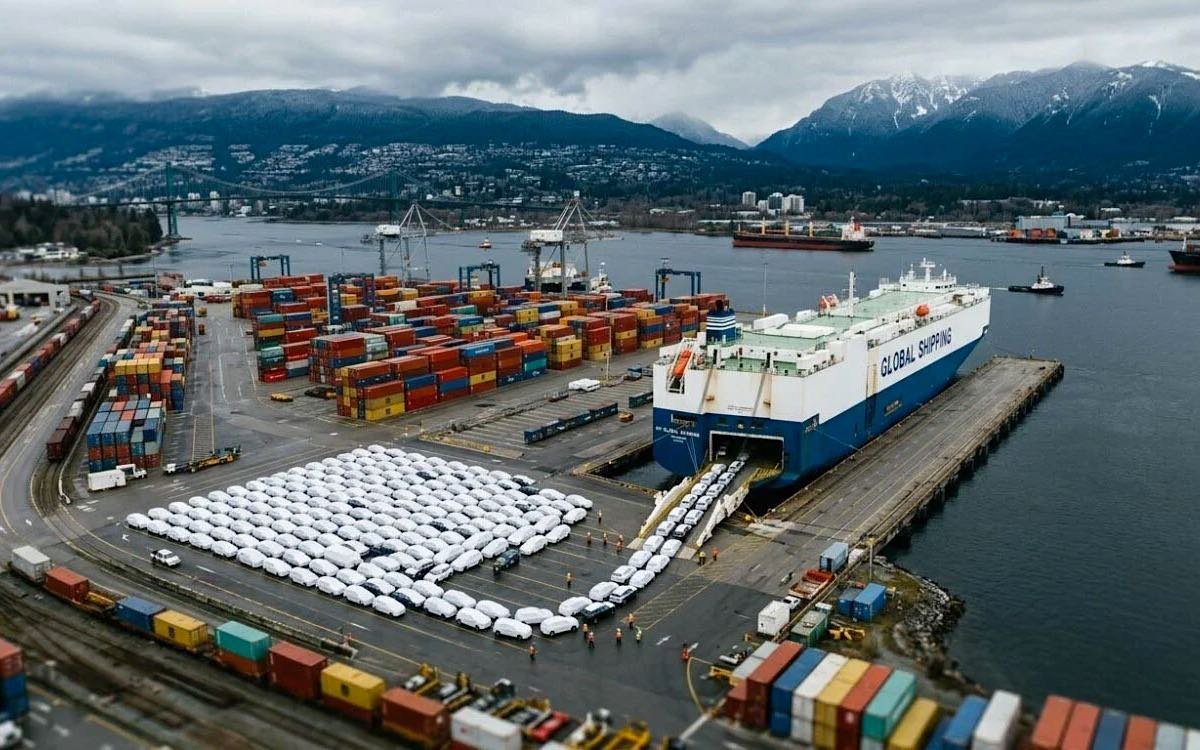
The first window opened March 1, admitting up to 24,500 vehicles through August. Only 15,603 were imported, leaving 8,897 permits unused, according to a tally by Global China EV. Those carried into a second window that opened Sept. 1 and runs through February, with 33,397 permits available. In exchange, China lowered tariffs on Canadian canola, lobster, peas, and crab.
The deal also requires Chinese automakers to establish joint ventures for vehicles or batteries within Canada inside three years. At the time, Carney framed the agreement as more than a tariff deal.
China’s Canadian EV Push: Where It Stands
Lotus is selling. Tesla has taken most of the quota. BYD, Chery and Geely have yet to deliver. Here’s where every brand stands, as of Nov. 2.
The Quota Ramp-Up: 49,000 to 70,000 Vehicles
Canada will allow a rising number of Chinese-built EVs each year, with an increasing share required to be priced under $35,000 CAD. No affordability requirement applies in year one — the cheapest models won’t be mandated until 2027.
Global Tariff Comparison: Where Canada Sits
At 6.1%, Canada’s tariff on Chinese EVs is dramatically lower than the United States (100%) and well below the EU’s tiered duties. Only Australia and Thailand impose no tariff at all.
EU tariffs are transitioning to a minimum price mechanism. Brazil tariff scheduled to reach 35% by end of 2026.
The Dealership Race: Who’s Furthest Along
Of the new Chinese entrants, only Lotus is delivering so far. BYD and Chery have no confirmed sales date, and Geely’s main brand says its first models arrive in 2027. Several timelines announced in the spring have slipped.
Global tariff rates: American Society of International Law · World Economic Forum · Rest of World
Dealership data: Electrek · CarNewsChina · Globe and Mail · Motor Illustrated
Additional: Automotive News · CleanTechnica · Canadian Auto Dealer
“In many respects the most important element is the beginning of discussions and expectation of Chinese investment in Canada, and partnership in Canada to produce vehicles over time,” he told reporters in Beijing.
BYD: big plans, no launch date
BYD, the world’s largest EV manufacturer, announced the most ambitious plan. The company hired Dealer Solutions Mergers & Acquisitions, a Markham, Ontario-based consultancy, to find locations for approximately 20 branded dealerships within its first year.
Toronto’s Greater Toronto Area is the primary target, with expansion planned for Vancouver, Montreal, and Calgary. BYD had shelved Canadian plans in 2024 when the 100% tariff made the market unviable. Within weeks of the January deal, those plans were back on the table.
Jason Zhao, director of Asian market development at DSMA, said preparations are well advanced. “We expect the vehicles will start landing by the end of this year,” he told Automotive News.
That timeline has not held. BYD has not announced a dealership or a launch date, and it is not yet taking orders, Global China EV reported. Drive Tesla Canada, citing Automotive News, says the first phase now looks like a handful of stores in Toronto, Vancouver and Montreal instead of 20. Zhao has said carmakers will be “very conservative” in that phase, and DSMA has reportedly received about 150 dealer applications, only a few of which are expected to proceed soon. Trade reports suggest sales are now more likely to start in 2027.
Chery, China’s top auto exporter, took a different approach.
The company has filed Canadian trademarks for five brands – Omoda, Jaecoo, Exeed, iCar, and Luxeed – and LinkedIn recruiters began approaching Canadian auto industry professionals in January about roles in vehicle engineering, electrical architecture, and regulatory certification.
Chery said in the spring that it was establishing a headquarters in the Toronto area and targeting consumer sales before year-end. Unlike BYD, which is courting large dealership groups, Chery appears open to working with retailers of varying sizes, giving it access to markets outside major urban centres.
Chery has since shipped about 150 vehicles to Canada, but those cars are being used for testing, certification and demonstration drives rather than sale, InsideEVs reported. A Canadian website for its Omoda and Jaecoo brands says they are “coming late 2026,” but lists no models, prices or dealers. In October, Chery vice-president Charlie Zhang told Reuters the company is now preparing for a launch “early next year,” according to Drive Tesla Canada.
Geely trademarks Zeekr
Geely, which already operates in Canada through its ownership of Volvo and Polestar, has trademarked its premium Chinese brand Zeekr – the first time it would sell one of its own Chinese-origin marques here.
Geely CEO Andy An has publicly confirmed the Canadian market entry. “Geely’s globalization is mostly through exports right now, but we will look to localize production,” An told Bloomberg, signalling that Canadian manufacturing could follow.
In October, Geely Auto said its main brand will enter Canada with its first models arriving in 2027, and that it has begun local operations and is building a retail and service network with local partners, CnEVPost reported. Models, pricing and locations have not been disclosed, and the report did not mention Zeekr. Dongfeng is also reportedly pursuing Canadian certification and may introduce two models in 2027.
One Chinese-built brand has already beaten all three to the punch. Lotus, owned by Geely, operated six authorized Canadian dealerships in March and planned to double that number to 12 by the end of 2026.
The company began shipping the Eletre, an electric SUV manufactured at its Wuhan plant, to Canada in May, starting with a first batch of 18. Deliveries have since reached the low hundreds. The tariff reduction is expected to cut the Eletre’s Canadian price roughly in half.
Lotus CEO Qingfeng Feng has been blunt about the opportunity. “The Canadian market opportunity is too precious to miss,” he said in March. “Since we’ve taken the lead, we must capitalise on this advantage.”
Tesla, not the newcomers, used most of the quota
Most of the vehicles imported at the lower rate in the first window came from established brands, not new entrants. Tesla, which ships its Model 3 from Shanghai, accounted for the large majority, according to Global China EV. Lotus’s Eletre came in the low hundreds, and Lincoln began bringing in its China-built Nautilus Hybrid in August, with several hundred so far.
Certification is a big part of the delay. Chinese automakers must certify vehicles to Canadian standards, a process that can take a year or more, and dealer groups have been reluctant to commit millions of dollars without clarity on inventory and long-term policy.
Dealers line up
Interest extended beyond manufacturers. According to industry sources in March, half of Canada’s large dealership groups were pursuing franchise agreements with Chinese brands.
Smaller and mid-sized dealer groups have shown strong interest as well, viewing the new entrants as an opportunity to add electrified vehicles to their portfolios at a time when legacy automakers are scaling back EV commitments.
The federal government, for its part, is pushing for deeper integration. Industry Minister Mélanie Joly has urged Canadian companies to partner with the incoming Chinese automakers.
“We believe that these great Canadian champions can partner with Chinese EV companies to make a Canadian-Chinese car to export it around the world,” Joly said in February.
Not everyone is sold
Not everyone is convinced the rush is wise. Magna International, Canada’s largest auto parts manufacturer, was Joly’s top candidate for a joint venture partner.
A Magna executive declined, saying the company prefers to remain a “neutral global partner” – though Magna already assembles XPeng vehicles at its plant in Graz, Austria.
Flavio Volpe, president of the Automotive Parts Manufacturers’ Association, has been the most vocal critic. “We have to remain vigilant so that this doesn’t become a permanent foothold,” he told BNN Bloomberg on the day the deal was announced.
In a separate interview with the Globe and Mail, Volpe warned: “This is not the global south where you dump product. If you want to be a partner and be a part of it, then you’re going to have to grind it out like everybody else.”
Others see the deal as a necessary corrective. “The federal government can leverage the China deal with complementary measures aimed at bringing in more affordable EVs from other carmakers,” wrote Trevor Melanson of Clean Energy Canada, arguing the quota could drive down EV prices across the board — not just for Chinese brands.
A shrinking market, a widening door
The Chinese brands are arriving into a Canadian EV market that has been contracting. Sales fell 25 per cent in 2025 and dropped another 37 per cent in January 2026, pushing EV market share down to just four per cent.
The combination of high sticker prices and the withdrawal of provincial incentives has left a gap that Chinese manufacturers — whose vehicles are typically priced $10,000 to $15,000 below comparable Western models — are eager to fill.
The first window closed in August with more than a third of its 24,500 slots unused, and the second runs through February. With BYD, Chery and Geely still working through certification and retail networks, the question is no longer whether Chinese brands will arrive in Canada. It is whether most of them will do so before 2027.