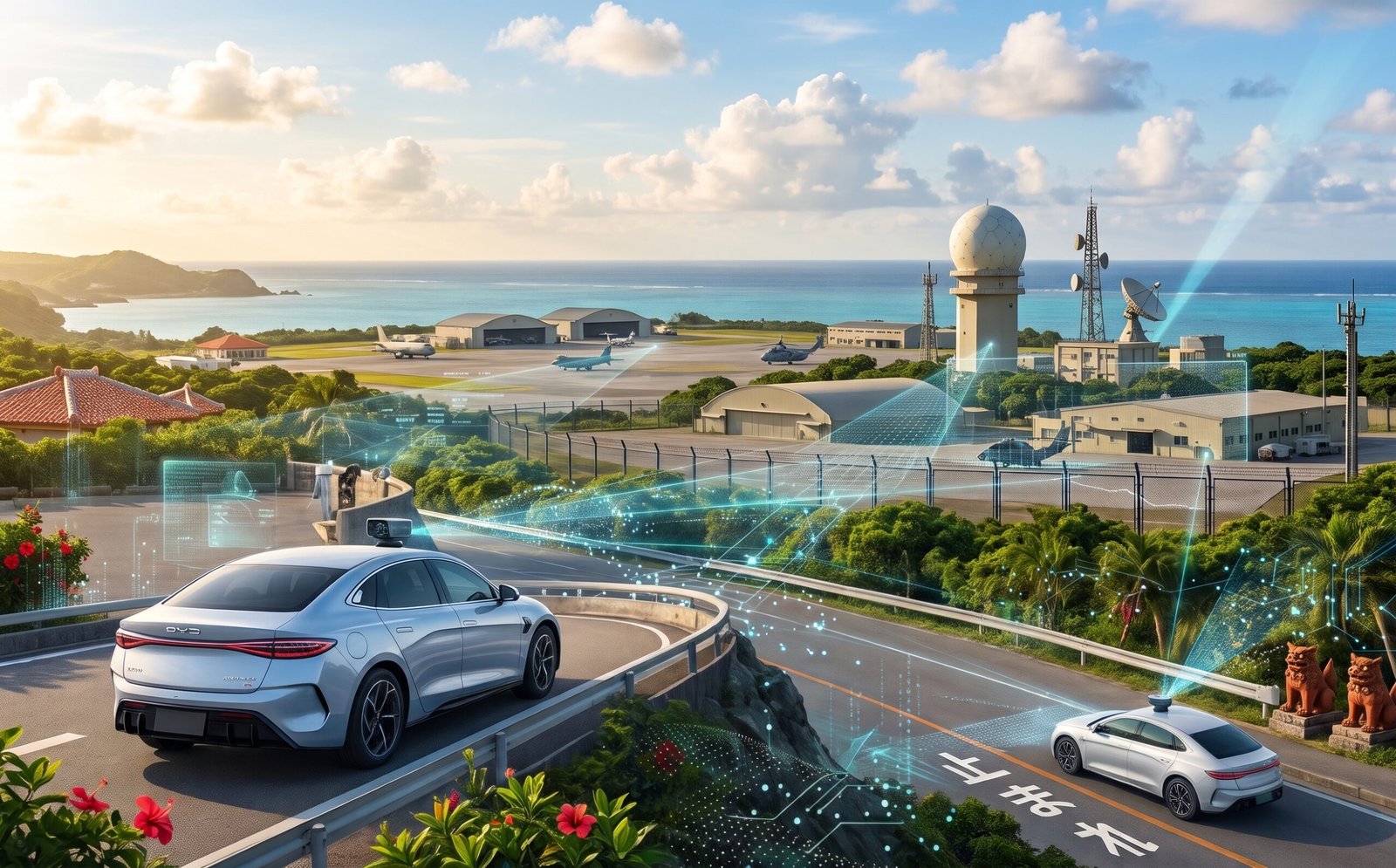
U.S. Forces Japan announced on Oct. 23, 2026, that BYD electric vehicles would be banned from Kadena Air Base in Okinawa, effective Oct. 26, South Korea’s Yonhap News Agency reported, citing unnamed U.S. military officials in Japan. The ban is a base access decision, not a finding of espionage, and that distinction runs through everything that follows.
What happened at Kadena
The restriction applies to privately owned vehicles, taxis, delivery trucks and contractor vehicles, Yonhap reported. Security personnel at the gates were instructed to block BYD vehicles and make drivers turn back, The Guardian reported on Oct. 27.
Wing commander Brig. Gen. John Gallemore made the decision after a thorough, consultative process which determined that these vehicles present an unacceptable and unmitigable risk to our personnel and our mission, spokeswoman Lt. Col. Alli Stormer said by email, Stars and Stripes reported on Oct. 28.
Kadena is the only U.S. base in Japan to ban BYD vehicles, Air Force Col. John Severns, spokesman for U.S. Forces Japan, said by email, Stars and Stripes reported. Severns added, “If that changes, we will announce it to our base populations.” U.S. Forces Korea said it has made no changes to its policies on Chinese vehicles entering its installations, Stars and Stripes reported.
The ban landed close to home for Okinawa drivers. Okinawa’s only BYD dealership opened on Sept. 5 in Tomigusuku city, Stars and Stripes reported, so the rule affects local owners as well as visitors and contractors.
One gate shut to BYD
Kadena is the only U.S. base in Japan to bar BYD vehicles. South Korea’s military is still counting Chinese connected cars registered on its own bases.
Why a car counts as a sensor
The concern, as reported by Yonhap, is that cameras, sensors, GPS devices and internet-connected technologies installed in vehicles could collect sensitive information from inside a base and leak it outside.
That framing matters because a modern connected car is not just transport. It records where it goes, what its cameras see, and when it enters and leaves a facility. The question at Kadena is not whether a car can drive, but whether a car should be allowed to observe.
The U.S. Commerce Department's connected-vehicle rule, issued in January 2025, was based on the same two national-security concerns, the American Manufacturing site reported: the possibility that foreign-controlled technologies could provide access to sensitive information, and the risk that outside actors could interfere with a vehicle's electronic systems.
The U.S. policy ladder behind the ban
Kadena did not happen in isolation. It sits on top of three earlier U.S. steps.
First, the Pentagon's June 8 update of its 1260H list of companies it says support China's military added 65 entities, including BYD, Nio, battery makers CALB and EVE Energy, Alibaba and Baidu, the Eletric Vehicles site reported. The Defense Department designated BYD as a Chinese military company in a notice published June 10 in the Federal Register, citing its affiliations with Chinese government agencies and its contributions to China's military-civil industrial base, Stars and Stripes reported.
BYD rejected the designation and said it would pursue administrative and legal avenues to protect its interests, the Eletric Vehicles site reported. Inclusion on the list carries procurement consequences, the site reported: from June 30, 2026, the Pentagon is barred from entering into, renewing or extending contracts with listed companies, and a wider ban on goods and services produced or developed by listed entities takes effect on June 30, 2027.
Second, the Commerce Department rule bars Chinese connected-vehicle software from model year 2027 and hardware from model year 2030, IANS reported on Nov. 4, reporting on an article in The National Interest. From model year 2027, the rule also bars Chinese-controlled automakers from selling connected cars in America at all, wherever they are built, IANS reported.
In June, the department denied Polestar, the Swedish brand owned by China's Geely, the authorisation it needed to sell cars in America from model year 2027 onward, even though one of its models is assembled in South Carolina, IANS reported.
Third, the Senate Commerce Committee advanced the Connected Vehicle Security Act of 2026 on July 22, the Eletric Vehicles site reported. The bipartisan bill from Senators Bernie Moreno and Elissa Slotkin would write the Commerce rule into law, the site reported.
Kadena is a separate step from all of that, the Eletric Vehicles site noted. It does not concern purchases. It decides which vehicles may physically enter a U.S. military installation abroad.
The allied gap: South Korea and Norway
The National Interest article reported by IANS on Nov. 4 makes a central point: American troops stationed overseas live and work under allied laws, and not all host nations have imposed similar restrictions.
In South Korea, the counts differ by date and source. Military data obtained by Rep. Kim Byung-joo of the Democratic Party, reported by Korea JoongAng Daily on Oct. 7, showed 135 Chinese-made connected cars registered with the armed forces: 44 with the Army, 42 with the Navy, 41 with the Air Force and eight with the Marine Corps. Of those, 118 belonged to officers and non-commissioned officers, Korea JoongAng Daily reported.
A later tally, reported by The Chosun Ilbo on Oct. 16 and cited by IANS, put the figure at at least 190 Chinese connected cars registered to enter South Korean military sites, including the Cheongju base that flies F-35s, the Yecheon wing receiving the first KF-21s, the Busan naval command where American carriers berth, and the submarine command at Jinhae.
Separately, unregistered Chinese vehicles had entered South Korean naval facilities at least 565 times this year, according to vehicle entry records the Navy submitted to Kim, Korea JoongAng Daily reported. The facilities included the Jinhae Naval Base Command, the Naval Logistics Command and the Submarine Force Command, the paper reported.
Seoul's defence ministry says it will restrict connected cars at sensitive sites by year's end, IANS reported. A ministry official responsible for security and cryptography, Yoon Hee-beom, said measures could be introduced before the end of the year if the amendment process moved quickly, Asia Daily reported, and the proposed restrictions would cover connected vehicles regardless of where they were manufactured.
Norway provided the most concrete anecdote in the National Interest article. In September, Norway's Home Guard conducted an exercise at Oslo's airport using rental cars that included Deepal models from Changan, a state-controlled Chinese automaker, NationPress reported, summarising the article. When soldiers interacted with the vehicles' touchscreens, they discovered stored camera footage documenting who had entered and exited the vehicles, the routes driven, and the access codes used to open gates and doors at military facilities, NationPress reported. An official at Norway's National Security Authority said, "We don't know for sure where the information is sent or what it's used for," NationPress reported.
The split among allies
Not every ally is following Kadena. Australia's Defence Minister Richard Marles said on Oct. 28 that Australia has not taken steps to restrict Chinese electric vehicles at military bases, Reuters reported via CarExpert, and that the United States had not asked Australia to take similar action. "We obviously continue to monitor all the safety around our bases in every respect, but we haven't taken that step," Marles said, CarExpert reported.
By contrast, Poland banned Chinese-manufactured vehicles from entering secured military facilities in 2026 unless specified recording or connectivity functions were disabled, CarExpert reported, and the UK and Czechia have also instituted similar bans. In Switzerland, connected vehicles are not permitted to drive near sensitive defence locations, CarExpert reported, citing Swiss outlet SRF.
China itself has banned Tesla vehicles from military bases, Drive reported, which is the reciprocal version of the same logic: a connected car from a rival power is treated as a potential observer, not just a vehicle.
What is not proven
The military has not publicly detailed the technical basis for the Kadena ban, and no evidence establishing that BYD vehicles have collected or transmitted sensitive information from Kadena has been publicly disclosed, Caricarz reported.
BYD did not immediately respond to a request for comment on the Kadena ban, the Ad-Hoc News site reported. That silence on Kadena is separate from BYD's rejection of the Pentagon designation, noted above.
In other words, Kadena is a risk decision, not a finding of espionage. The distinction matters, because it is also the reason the ban is debatable: a base commander can act on risk without waiting for proof of a leak, and critics can fairly ask what specific risk was found.
What to watch next
Four things will determine whether Kadena was a one-base decision or the start of a pattern.
First, whether U.S. Forces Korea or other U.S. bases in Japan, such as Marine Corps Air Station Futenma on Okinawa, adopt similar restrictions. No decision beyond Kadena has been announced, the Eletric Vehicles site reported.
Second, whether Seoul meets its own year-end target for restricting connected cars at sensitive sites, and whether that restriction covers all connected vehicles or only Chinese-made ones.
Third, the U.S. domestic timeline: the model year 2027 software bar, the 2030 hardware bar, and the June 30, 2027 wider Pentagon procurement ban for listed entities.
Fourth, the loophole the American Manufacturing site flagged on Nov. 4: the Commerce connected-vehicle rule applies to vehicles under 10,001 pounds and does not apply to vehicles already on the road, so heavy-duty transit buses, terminal tractors and other vehicles manufactured by Chinese companies currently fall outside the rule's vehicle-weight scope. BYD opened a bus manufacturing facility in Lancaster, California, in 2013, the site reported, and its U.S. commercial-vehicle operation now operates under the RIDE name.
That last point is why Kadena matters beyond Okinawa. A ban at one gate is easy to enforce. A consistent rule for every connected vehicle that can enter a sensitive site, whether it is a passenger car, a bus, or a delivery truck, is much harder, and that is the rule allies are now being asked to write.
Sources: Stars and Stripes, via Military.com, Oct. 29; IANS via New Kerala, Nov. 4; Korea JoongAng Daily, Oct. 7; CarExpert; Drive; Eletric Vehicles; American Manufacturing, Nov. 4.